A sports car with a clear purpose
The story began with the Healey 100, shown at the 1952 London Motor Show. Its reception led to an agreement with Austin, and the car entered production as the Austin-Healey 100. The name pointed to its intended ability to reach 100 mph, while the car’s appeal rested on a straightforward formula: a strong Austin engine, a low body and open-air motoring without excessive complexity.
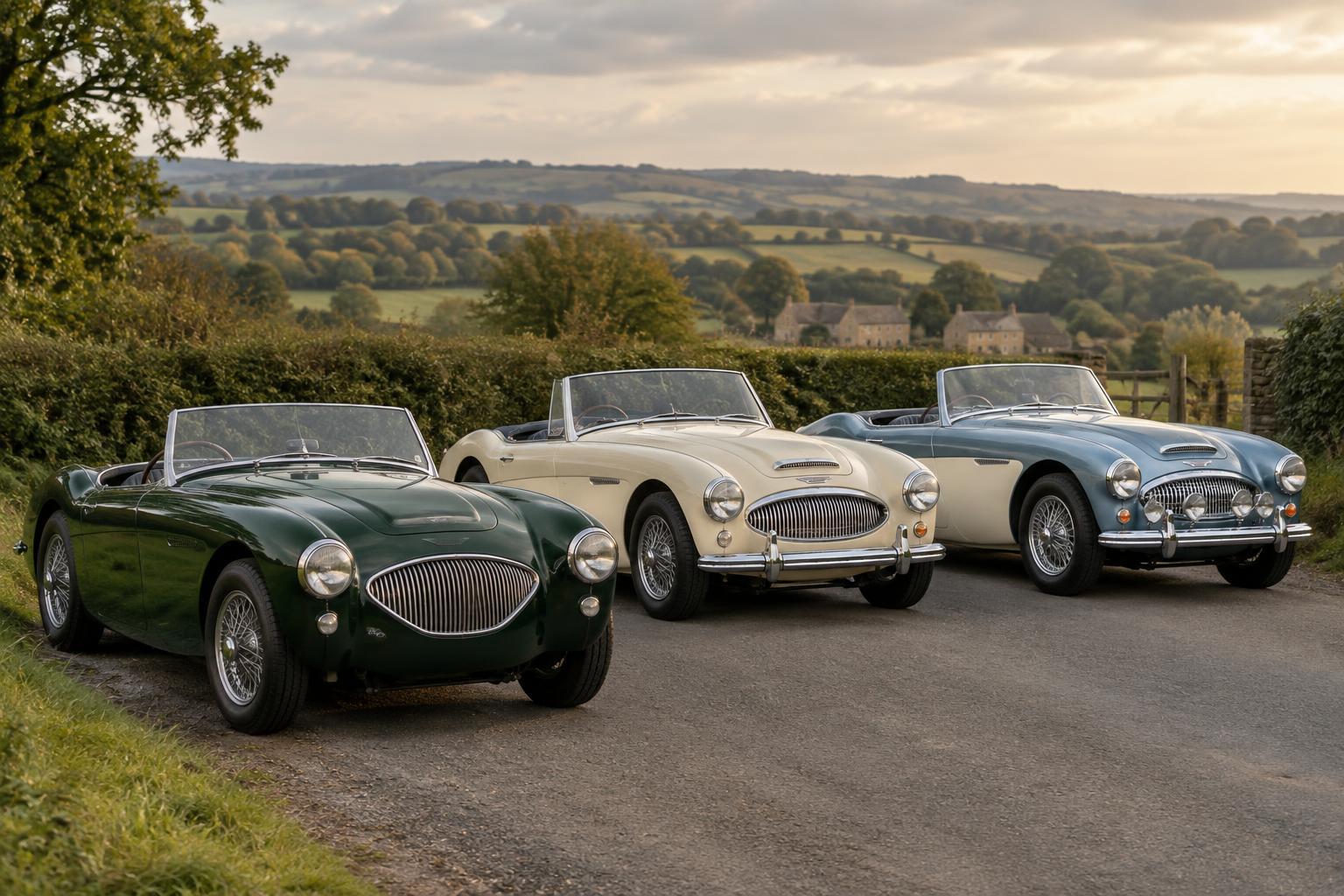
Today, “Big Healey” is the familiar collective name for the Austin-Healey 100, 100-Six and 3000. It helps distinguish them from the smaller Sprite, but it can also hide how much the larger cars changed. The early four-cylinder roadster and the late 3000 share a recognisable silhouette and character, yet they offer noticeably different ways to enjoy a journey.
The Austin-Healey 100: light on its feet
The first production 100, commonly identified by its BN1 model code, used a 2.6-litre four-cylinder engine. It paired a three-speed gearbox with overdrive, giving drivers a useful extra ratio for open roads. Its low windscreen could be folded down, reinforcing the car’s sporting, elemental feel. With two seats and relatively little emphasis on comfort, the original 100 was closer in spirit to a brisk roadster than a relaxed grand tourer.
The later BN2 brought a four-speed gearbox and detail improvements. The period also produced more specialised versions, including the tuned 100M and the competition-oriented 100S. Those cars are part of the model’s history, but they should not define expectations of an ordinary 100. For most owners, the attraction is the standard car’s direct response, purposeful appearance and sense that the driver is closely involved in every mile.
The 100-Six changes the balance
Introduced in 1956, the 100-Six marked the most obvious change in the family’s character. A 2.6-litre six-cylinder engine replaced the four, and a longer wheelbase made room for a revised body. Early cars offered occasional rear seats in a 2+2 layout; a two-seat version followed. The familiar long bonnet and sweeping sides remained, but the car had begun to move toward more spacious touring.
The six-cylinder engine changed the experience as well as the specification. Rather than simply treating the 100-Six as a stepping stone to the 3000, it is worth seeing it as a distinct model: smoother in character than the four-cylinder 100, yet still recognisably an open British sports car. Its mix of body styles also shows how Austin-Healey was adapting the design to buyers who wanted a little more versatility.
The 3000 grows into a grand tourer
The Austin-Healey 3000 arrived in 1959 with a six-cylinder engine enlarged to roughly three litres and front disc brakes. Those changes suited a car expected to cover distance with greater pace and confidence. Two-seat and 2+2 bodies were available during the model’s life, so “3000” describes a family of cars rather than one fixed interior arrangement.
Successive versions developed that touring role. The Mk II brought changes to the engine and body range, while the Mk III, introduced in 1964, became the most refined of the line. It offered more power and a more comfortable cabin, though it remained an open sports car of its era rather than a modern, insulated cruiser. By the time production ended in 1967, the Big Healey had travelled a long way from the spare original 100 without losing its unmistakable profile.
Understanding the appeal of each generation
There is no single version that best represents the Big Healey. The four-cylinder 100 appeals to those who value simplicity and an especially direct driving feel. The 100-Six offers the transition to six-cylinder character, while the 3000 places more emphasis on power and longer-distance comfort. Model codes, seating layouts and later changes matter because two cars carrying similar badges may feel quite different on the road.
For anyone exploring the history through a surviving car, condition and originality deserve as much attention as the badge. Many examples have been restored or modified over decades of use, sometimes with parts or features from a later specification. That does not necessarily diminish enjoyment, but it makes careful identification worthwhile. The lasting achievement of the Big Healey is that its evolution is easy to see and feel: one sporting idea, gradually reshaped for the open road.