A small car for a changing market
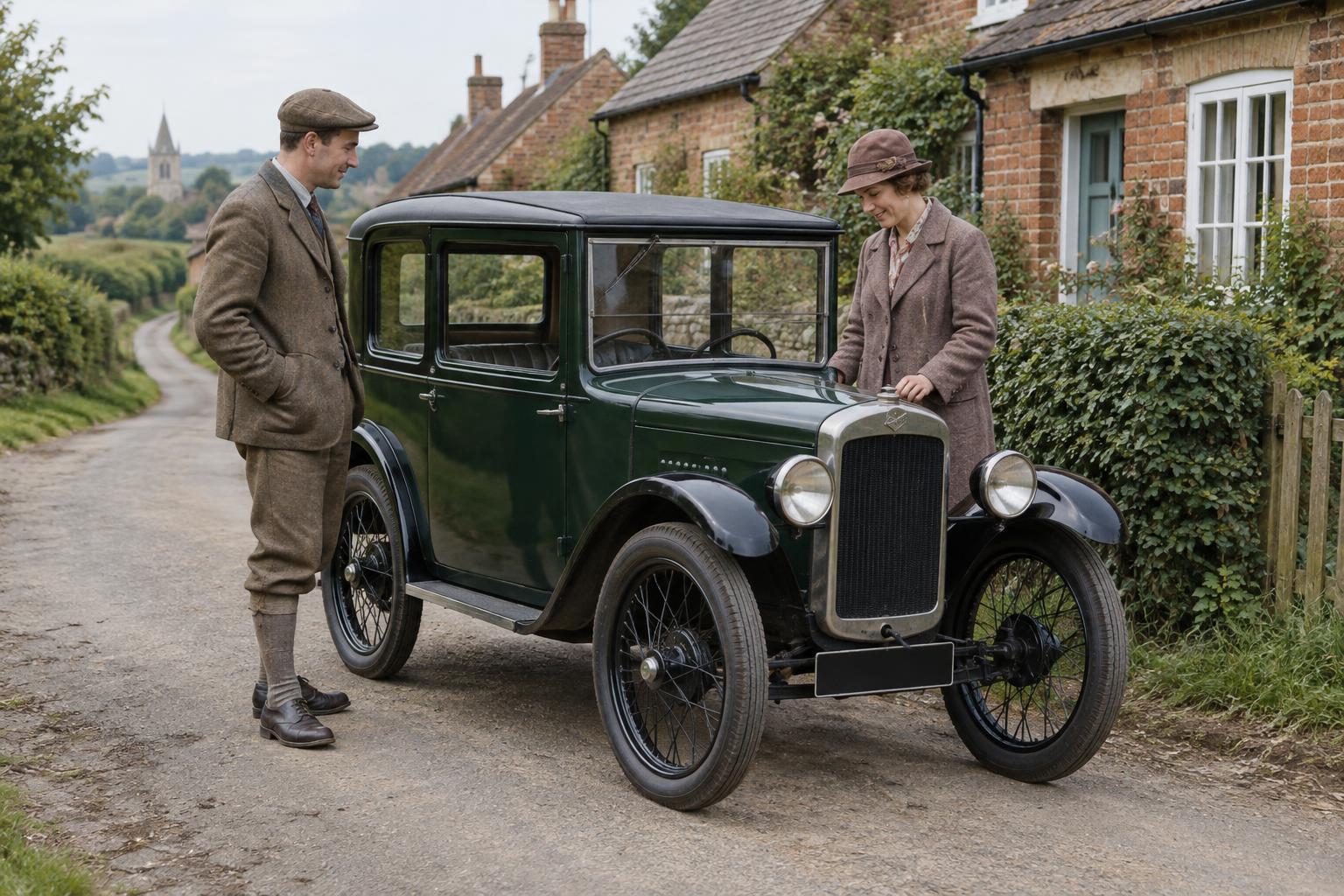
When the Austin Seven appeared in 1922, owning a car was still beyond the means of many British households. Buyers seeking inexpensive transport might choose a motorcycle and sidecar or one of the lightweight cyclecars then on sale. Larger cars offered more room and refinement, but their purchase price and running costs could be daunting. The Seven occupied a useful middle ground: it was a compact, conventional car designed to carry a small family without the scale or expense of a larger model.
That distinction matters when describing it as affordable. The Seven did not put a new car within everyone’s reach, and its modest cabin could be a squeeze. What it did offer was a more attainable route into four-wheeled motoring for people who wanted shelter from the weather, space for passengers and luggage, and a vehicle suited to everyday journeys. It helped make the small car a serious choice rather than merely a compromise.
Why its size made a difference
The Seven’s modest dimensions were central to its appeal. A small, light car needed less power to move than a heavier one, while its compact mechanical components helped keep the design straightforward. Its four-cylinder engine was small, and performance was best understood in the context of the roads and expectations of its day. It was not built to make long distances effortless; it was built to make ordinary trips possible with a manageable car.
Running costs mattered as much as the showroom price. Fuel, tyres, tax, repairs and storage all shaped an owner’s decision, and a smaller car could ease several of those pressures. None disappeared: a Seven still needed maintenance, and an unexpected repair could be significant for a household budget. But the combination of modest size and practical four-seat accommodation gave buyers a persuasive reason to consider a car instead of other forms of personal transport.
One design, many uses
Part of the Seven’s importance lies in how readily the basic car could serve different purposes. Open tourers suited buyers who valued simple, relatively light transport; enclosed bodies offered greater protection in poor weather. Vans and other working versions showed that the car’s usefulness extended beyond family outings. Across its production life, the Seven appeared in a wide range of body styles, giving buyers more choice than the phrase “small car” might suggest.
Its compact mechanical layout also attracted people interested in sporting and special-bodied cars. That adaptability should not obscure the experience of the ordinary owner, whose priorities were more likely to be getting to work, visiting relatives or taking a day trip. The Seven’s broader achievement was to show that a small car could fit into many parts of daily life. It was not simply a cheaper version of a large car; it helped establish a distinct and useful kind of motoring.
An influence beyond its original buyers
The Austin Seven became one of the defining British small cars of the interwar period. Its success demonstrated sustained demand for practical cars at the smaller end of the market, while the design also gained a life beyond Britain through overseas versions and adaptations. It was not the only car to answer that demand, nor did it single-handedly create mass motoring. Other manufacturers, changing household finances and improvements to roads and services all formed part of the wider story.
For today’s enthusiast, the Seven offers a direct way to understand what affordable motoring meant in the 1920s. Its narrow cabin, simple controls and unhurried pace are reminders that early car ownership involved different expectations of comfort and speed. Yet the underlying proposition remains familiar: a vehicle does not have to be large or powerful to be useful. By making the small car feel like a practical choice for more people, the Austin Seven left a mark well beyond its own dimensions.