Why a parked classic still needs battery care
A battery slowly loses charge even when it is disconnected from a car. Leave it connected, and a clock, alarm or other electrical accessory may draw additional power. A weak battery then has a harder job turning a cold engine, particularly if the car has been standing long enough for oil to drain from the surfaces it normally coats. Repeated attempts to start an unwilling engine can drain the remaining charge quickly.
Short, occasional runs are not a reliable cure. Starting takes energy, and a brief idle may not replace it. If you can use the car, a proper drive that brings it up to normal operating temperature is generally more useful than running the engine for a few minutes on the driveway. When a drive is not practical, a suitable battery maintenance charger is the more predictable option.
Begin with the battery and its connections
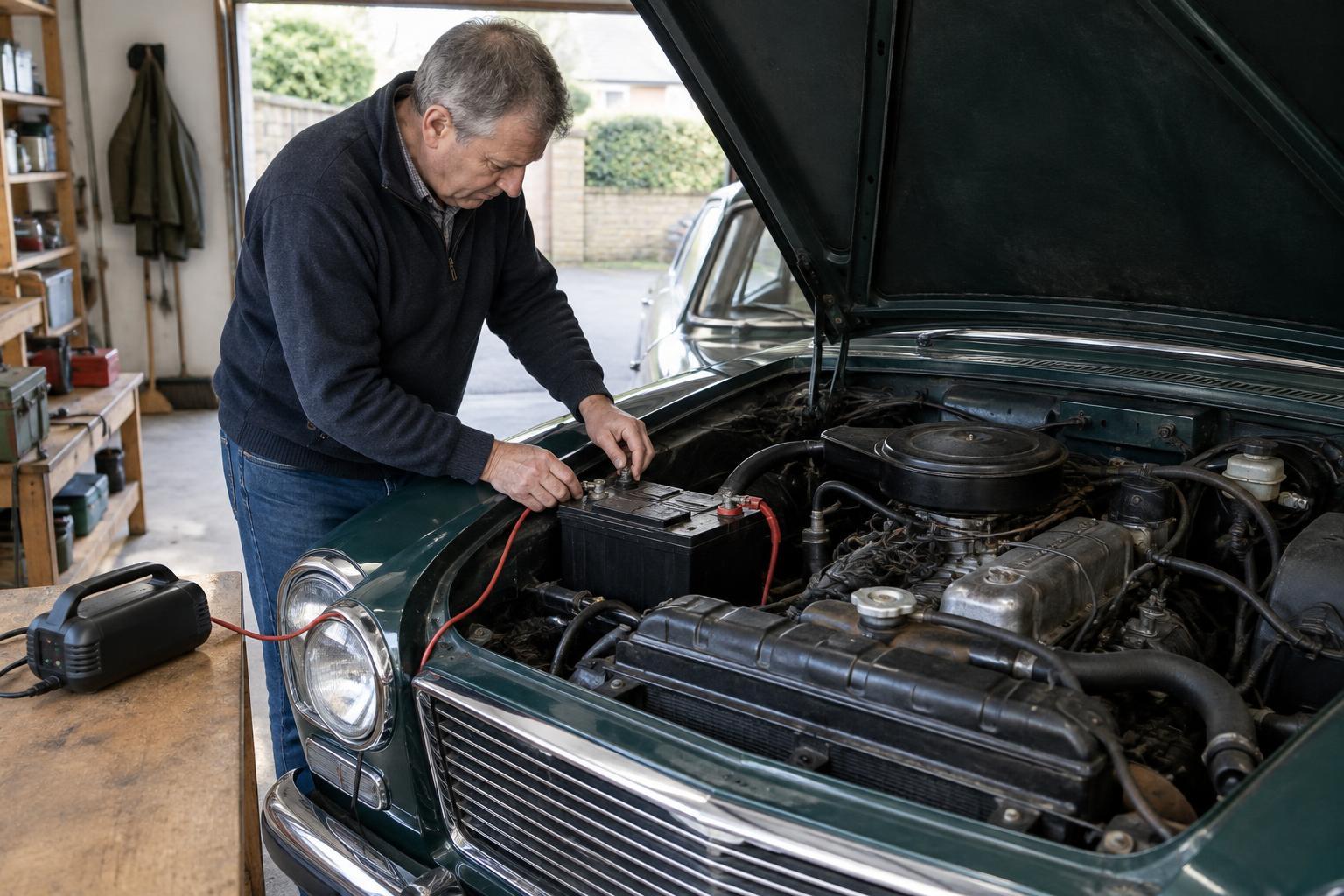
Before connecting a charger, look at the battery case, hold-down clamp, cables and terminals. The battery should be secure, with clean, firm connections and no visible cracks, swelling or leaks. A loose clamp can let a heavy battery move on a rough road; a poor terminal connection can mimic a failing battery by restricting current to the starter. If the case is damaged or leaking, do not charge it. Arrange for the battery to be assessed or replaced safely.
Light corrosion around a terminal can be cleaned with the battery disconnected, using eye protection and a method appropriate to the battery and vehicle. Keep tools from bridging the terminals or touching a terminal and bodywork at the same time. On a car with a serviceable flooded battery, check the electrolyte only as its manufacturer directs; sealed batteries are not meant to be opened. If you are unsure what type is fitted, read its label before attempting any maintenance.
Choose a charger that suits the battery
For a car parked for extended periods, consider a charger with an automatic maintenance mode designed for the battery’s chemistry and voltage. A conventional 12-volt lead-acid battery, an AGM battery and a lithium replacement may require different settings or different chargers. Older cars may also have a 6-volt system. Do not assume that a charger suitable for one vehicle is suitable for another: check both the battery label and the charger instructions.
Many British classics were built with positive-earth electrical systems, although individual cars may have been converted. Establish the car’s actual polarity rather than relying on its model or age, and connect the charger according to its instructions. Charge in a ventilated location away from flames and sparks. Switch off or unplug the charger before attaching or removing its leads, unless its instructions specify a different procedure. Route cables so they cannot be pinched by a bonnet or become a trip hazard.
A maintenance charger should manage the battery rather than charge it continuously at a fixed high rate. Even so, it is worth checking the installation periodically. An unexpectedly hot battery, a strong odour, repeated charger faults or a battery that will not hold charge calls for further investigation, not another cycle of attempted starts.
Decide whether to disconnect the battery
Disconnecting a battery can reduce the drain from accessories during storage, but it does not stop the battery’s own gradual loss of charge. It may also disable an alarm, clock or other equipment. If you plan to leave the battery connected, a suitable maintenance charger can help keep it ready, provided you have a safe power arrangement and can follow the charger’s guidance.
If you disconnect it, identify which terminal is connected to the car’s body: that is the earth terminal. Remove the earth-connected lead first and reconnect it last. This matters on both negative-earth and positive-earth cars because it reduces the chance of a tool accidentally completing a circuit through the bodywork. Protect the loose lead from touching its terminal again. If the car has unfamiliar modifications or you cannot establish its polarity confidently, ask someone experienced with classic-car electrics to check it before you proceed.
Make the battery part of a storage routine
Before a planned spell off the road, give the battery a full charge using the appropriate equipment, note its condition and make sure it remains securely mounted. Check it at intervals rather than waiting for the next outing to discover a problem. The useful interval depends on the battery, the temperature, connected accessories and how long the car sits, so a routine tailored to your garage and vehicle is better than a universal calendar rule.
When it is time to drive again, remove the charger and secure its leads before starting. Confirm that the battery connections are tight and that no tools have been left in the engine bay. If the starter remains sluggish after a proper charge, the battery may be ageing, but cables, earth straps and the charging system can also be responsible. Working through those possibilities methodically is kinder to a classic than repeatedly asking a weak battery to bring it to life.