What a roadbook is for
A roadbook gives a crew a planned route through a sequence of junctions and landmarks. On a non-competitive classic-car event, its purpose is usually to help participants enjoy the drive and find their way between stops, not to set a fast pace. The organiser’s opening notes matter as much as the individual directions: they may explain how distances are measured, where the route begins and how to identify a checkpoint or lunch stop.
Read those notes before setting off rather than trying to interpret them on the move. Check whether the book uses miles or kilometres, whether distances run from the start or reset at certain points, and whether an instruction refers to a junction, a signpost or another visible feature. Conventions vary between organisers, so treat the event’s own explanation as the guide.
Make sense of diagrams and distances
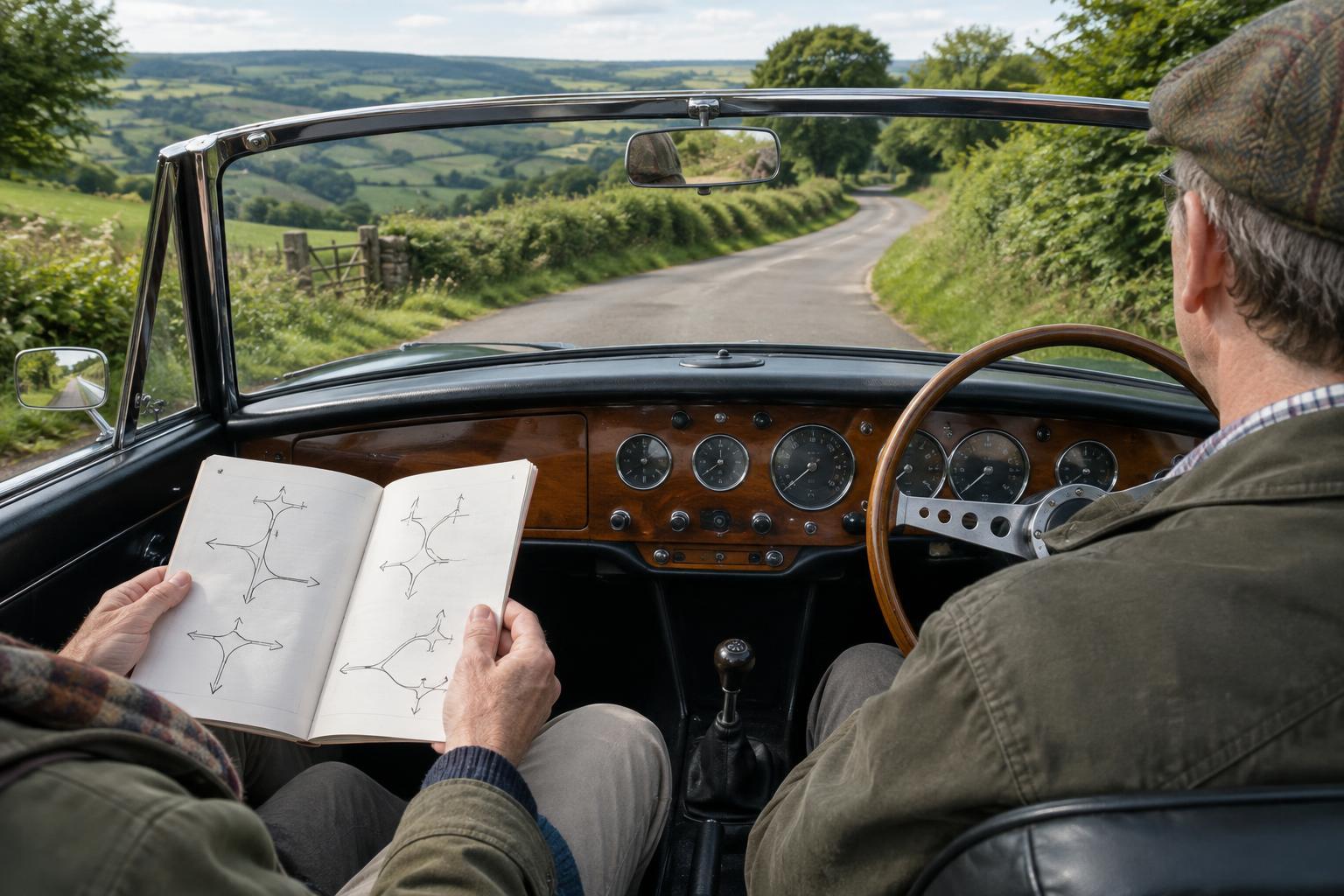
Many roadbooks use small junction drawings, sometimes called tulip diagrams. These typically show the car approaching a junction and the route to take through it. A dot often marks the approach, while an arrow or heavier line indicates the exit, but check the key supplied with your book before relying on that convention. The drawing represents the road layout, not necessarily the view from the driver’s seat.
Mileage columns help you decide when to look for the next instruction. A cumulative figure gives the distance from a stated starting or reset point; an interval figure gives the distance since the previous instruction. For example, if one instruction is at 12.0 miles and the next at 12.6, the next feature should be roughly six-tenths of a mile farther on. An older car’s odometer, tyre size and the organiser’s measuring vehicle can produce small differences, so use mileage alongside the junction shape and any written clue rather than treating it as exact.
Prepare the car and the crew
A passenger can handle the roadbook while the driver concentrates on the road. Before departure, agree on simple calls: the approximate distance to the next instruction, the junction to watch for and the intended exit. “In half a mile, take the second exit at the roundabout” is easier to act on than a last-second call of “right.” If you are driving alone, plan to stop somewhere safe to check the route; do not read a roadbook while driving.
Keep the book accessible to the navigator without placing it where it blocks the view or interferes with controls. A pencil, a bookmark and a way to track distance can be useful, though a trip meter is not essential if you can follow landmarks and stop to check your position. At the start, confirm that the first instruction matches the road in front of you. Reset the trip meter only where the roadbook calls for it, and note the reading if a reset point is unclear.
Work through each instruction
The navigator can look one instruction ahead while keeping the current one in view. First identify the expected distance, then read the junction drawing and any text. As the car approaches, compare all three with what is visible. A side road, a staggered crossroads and a fork can look similar on paper until you are close enough to see the layout. If the instruction does not fit, avoid making a sudden turn just to satisfy the mileage.
After a turn, confirm the next instruction and the distance to it. This rhythm helps prevent a common mistake: making the correct turn, then continuing to navigate from the previous line. Road signs, temporary restrictions and conditions on the day take precedence over the printed route. If a road is closed or a direction cannot be taken safely and lawfully, find a safe place to stop and use the organiser’s stated procedure for route problems.
Recover without turning it into a race
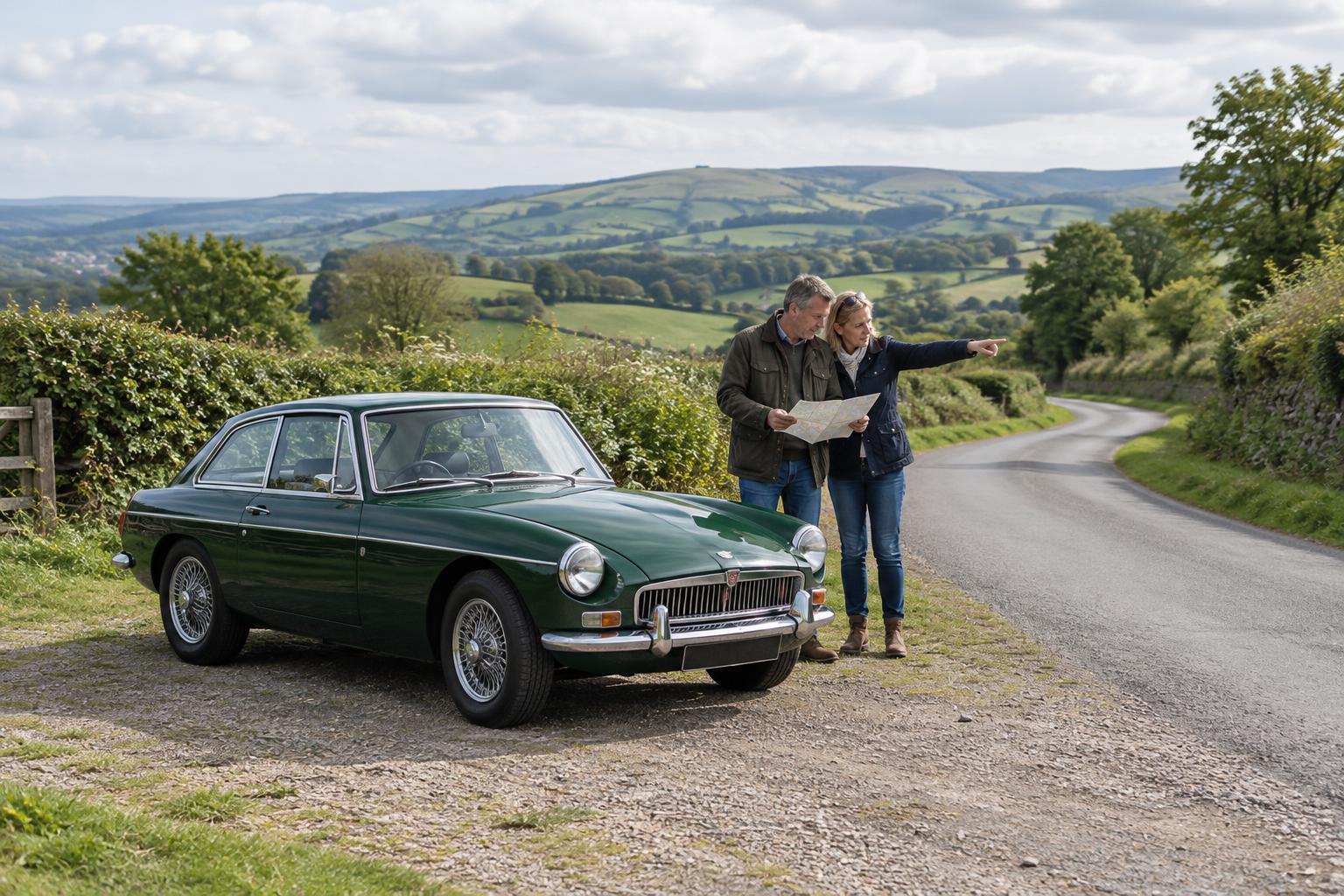
Missing a turn is an ordinary part of touring, especially when a junction is partly hidden or traffic makes an instruction difficult to spot. Tell the driver as soon as the mismatch becomes clear, but leave any change of direction until it can be made safely. Pull over where permitted, identify the last junction you recognised and compare it with the next entry. A map or the event’s contact details may help if you cannot rejoin confidently.
There is no need to catch up by driving faster. A non-competitive tour is better approached as a shared day out: allow time for older cars, changing weather and conversations at stops. With a little preparation, the roadbook becomes more than a list of turns. It gives driver and navigator a way to notice the lanes, villages and scenery together while keeping the journey relaxed.