The XK120 makes an entrance
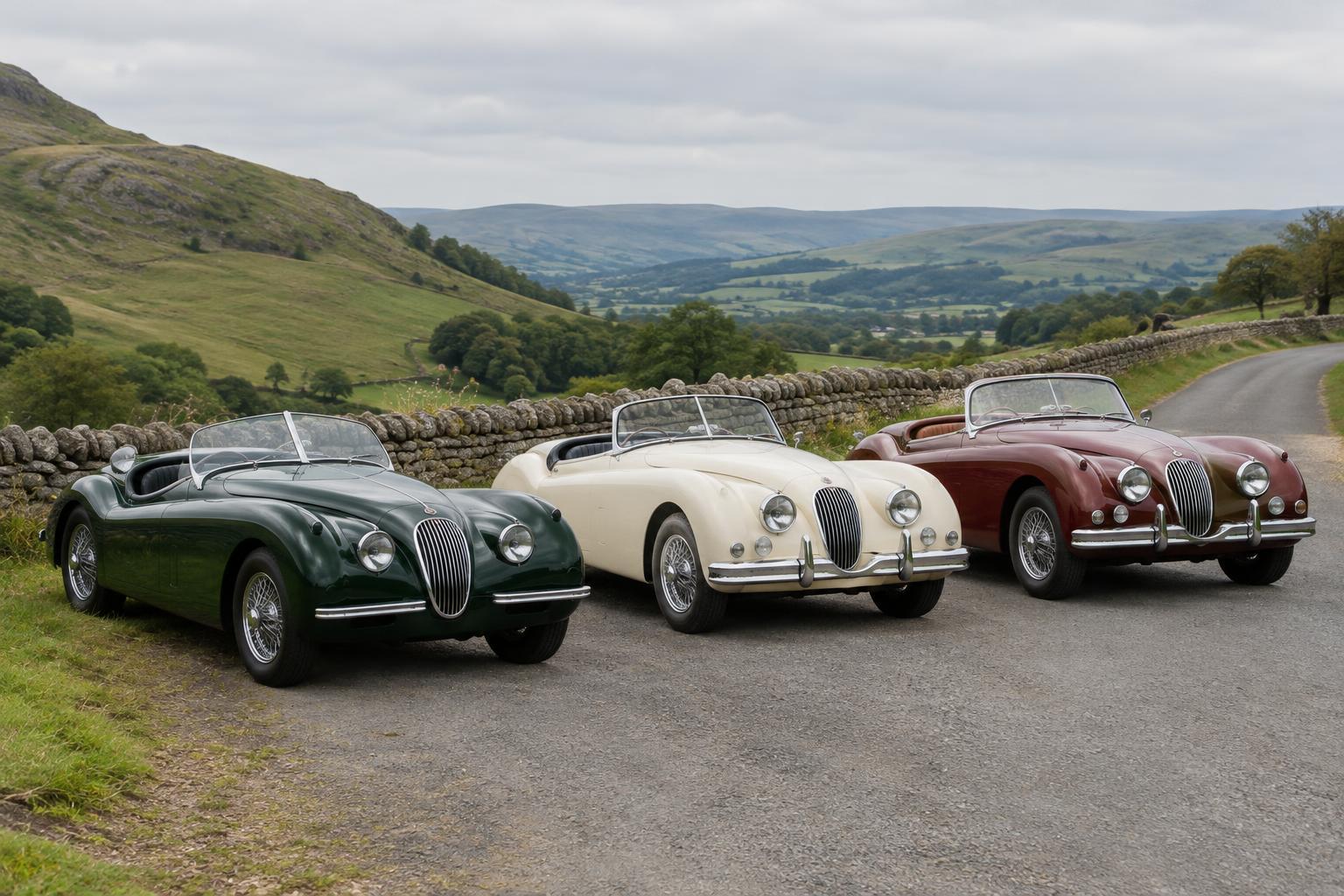
Jaguar unveiled the XK120 at the 1948 London Motor Show, introducing both a new sports car and its twin-overhead-camshaft XK six-cylinder engine. The car’s long bonnet, low body and flowing wings made an immediate impression. Its name referred to a 120 mph speed target, an attention-grabbing statement of intent rather than a guarantee about every car in every condition.
Early XK120s had aluminium body panels, but Jaguar soon moved to predominantly steel body construction as production developed. The open two-seater, often called a roadster, was joined by a fixed-head coupé and a drophead coupé. Those versions gave buyers distinct choices: an elemental open car, an enclosed car, or a more weather-protected convertible. The XK120 established the lineage’s central appeal: strong performance paired with a shape that looked at home on both a winding road and a grand tour.
The XK140 adds room for the road
Introduced in 1954, the XK140 followed the XK120 without discarding its character. Jaguar revised the chassis layout to create more usable cabin space, a welcome change for drivers who admired the earlier car but found it snug. Rack-and-pinion steering was another significant development. With its familiar six-cylinder engine and three body styles, the XK140 remained recognisably part of the same family.
From outside, it can be easy to mistake an XK140 for an XK120 at a glance. Look for changes in the bumpers and grille, then consider the car as a whole: the XK140 was less a clean-sheet replacement than a response to the experience of living with an XK120. Its improvements made longer journeys more inviting while preserving the low-slung appearance that had drawn attention to the original.
The XK150 moves toward grand touring
The XK150 arrived in 1957 with a more substantial visual revision. Its broader body sides and one-piece curved windscreen give it a fuller, more modern look than its predecessors. The family resemblance remains clear in the long bonnet and compact cabin, but the XK150 feels less delicate in outline. It continued to be offered in open two-seater, fixed-head coupé and drophead coupé forms.
Four-wheel disc brakes were an important part of the XK150’s specification, reflecting a greater emphasis on braking performance alongside engine power. The model initially used a 3.4-litre XK engine; a 3.8-litre version came later. More powerful S variants added another choice for buyers interested in performance. Rather than replacing the XK120’s idea of a fast British sports car, the XK150 adapted it for drivers expecting more space, equipment and ease on longer trips.
How to read the three cars together
The simplest way to understand the sequence is as a progression in emphasis. The XK120 introduced the dramatic shape and engine. The XK140 kept the essential formula while addressing practical limitations. The XK150 brought a broader body, stronger braking specification and a more developed grand-touring character. Each change makes more sense when viewed against the car before it than when the models are treated as unrelated classics.
Body style matters as much as model number. An open two-seater can offer a very different experience from a fixed-head coupé of the same generation, particularly in weather protection, cabin atmosphere and luggage access. Condition and past alterations also shape how any surviving example drives. An XK badge identifies a place in the lineage, but it cannot tell the whole story of an individual car.
Why the lineage still interests enthusiasts
The XK series offers a compact lesson in postwar sports-car development. Across three models, Jaguar retained a distinctive engine and recognisable proportions while making the cars more accommodating. That continuity helps explain why enthusiasts can favour different generations for different reasons: the XK120’s spare early character, the XK140’s balance, or the XK150’s touring capability.
For anyone viewing one at a show or considering ownership, start with the details that changed between generations, then look beyond them. Notice the body style, the fit of the driving position and evidence of careful maintenance or restoration. These cars share a lineage, but their histories as individual machines may be just as revealing as the model names on their badges.