A roadster designed for more than speed
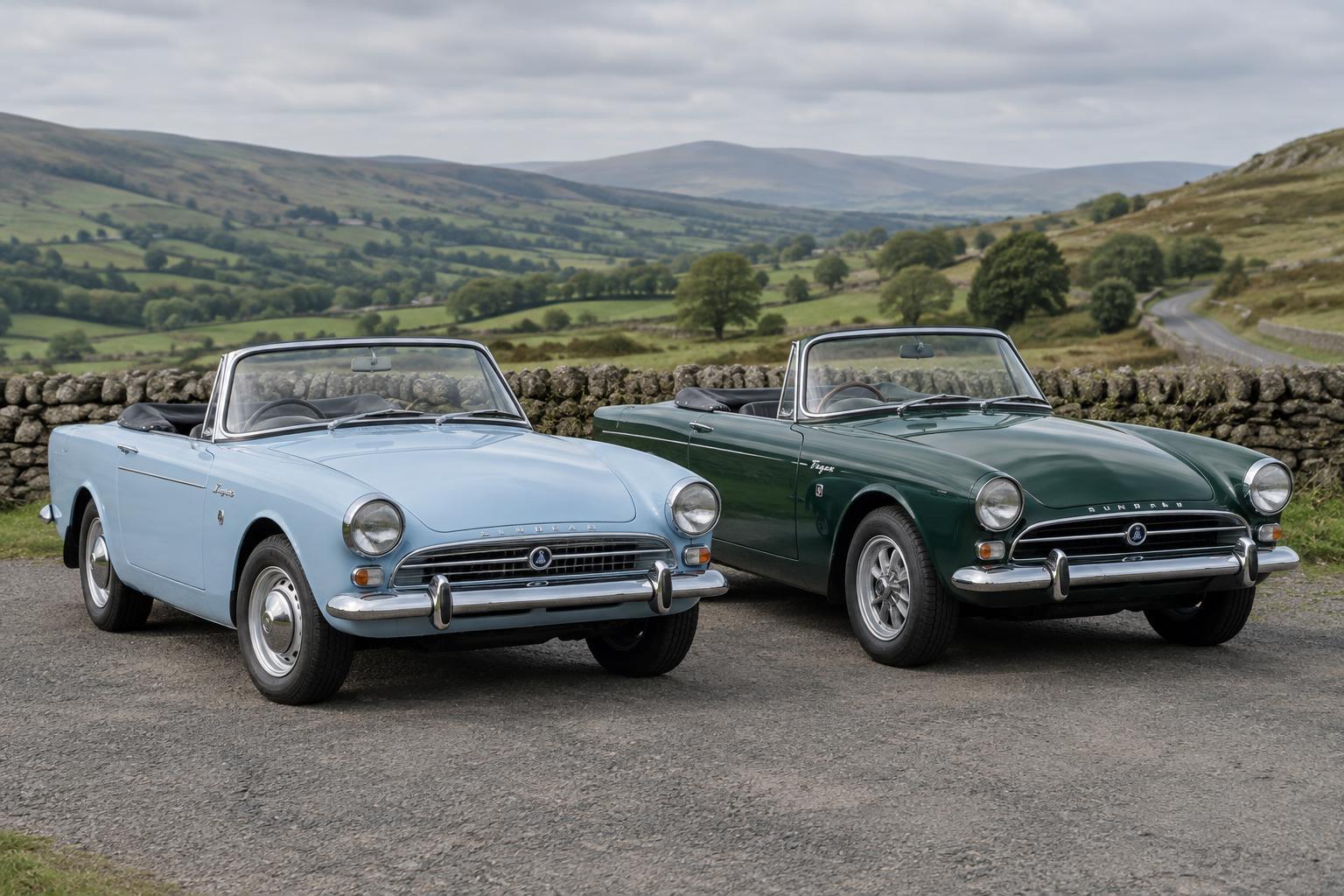
When the Rootes Group introduced the Sunbeam Alpine in 1959, it offered a fresh take on the British open two-seater. Rather than pursuing the most stripped-down sports-car experience, the Alpine combined tidy styling with a degree of comfort and everyday usability. Its shape was modern for its time, with pronounced tailfins on early cars that became more restrained as the model evolved.
The Alpine used a four-cylinder engine and was developed through five series before production ended in 1968. Changes across those series included revisions to styling, equipment and engine capacity, so an early Alpine and a late one do not feel or look quite the same. What remained consistent was the basic proposition: an approachable open car suited to a winding road or a longer outing, without asking its driver to treat every journey as a competition.
That character matters when comparing the Alpine with the Tiger. The Alpine was not merely a Tiger awaiting a bigger engine. It was a complete roadster in its own right, and its more modest power was part of a balanced, relaxed driving experience.
How the Tiger changed the formula
The Sunbeam Tiger took the Alpine’s familiar body and added a substantially different source of power: a Ford V8. The idea promised stronger acceleration while retaining the compact dimensions and open-air appeal of the British roadster. Carroll Shelby was involved in the project’s early development, and production cars were assembled by Jensen in Britain. The Tiger arrived in the mid-1960s and remained in production for a much shorter period than the Alpine.
Most Tigers used a 260-cubic-inch Ford V8; the later, less common Mark II used a 289-cubic-inch engine. Those numbers help explain the car’s reputation, but they do not tell the whole story. A V8 in a small roadster changes its sound, throttle response and sense of effort. Where an Alpine encourages its driver to make use of the four-cylinder engine’s range, a Tiger can gather speed with less apparent exertion.
The transformation was not invisible beneath the bodywork. Accommodating the V8 required mechanical changes, and the Tiger’s driving character reflects more than an engine swap. Yet the family likeness remains strong. To someone seeing the cars parked together, badges and other details may announce the difference before the proportions do; on the road, the distinction is much harder to miss.
Two characters, not a winner and a runner-up
It is tempting to rank the cars by power alone, but that misses why both have lasting appeal. The Alpine offers the pleasure of working with a lighter-duty four-cylinder drivetrain and enjoying the car at a pace that suits ordinary roads. Its appeal lies partly in how readily a driver can engage with its steering, gears and engine without needing dramatic acceleration to make a journey memorable.
The Tiger provides a different kind of theatre. Its V8 gives the compact roadster an unmistakable voice and a muscular quality that sets it apart from many of its British contemporaries. For some enthusiasts, that unexpected combination is the point: familiar Alpine lines paired with the sound and urge of an American engine.
Neither description guarantees how an individual car will feel. Tyres, suspension condition, previous repairs and modifications can have a considerable effect. A carefully maintained Alpine may be more satisfying than a neglected Tiger, while a well-sorted Tiger can make a persuasive case for the V8 concept. The comparison works best as a question of taste rather than a contest with one correct answer.
Why their shared history still matters
The Alpine and Tiger capture two ways of answering a familiar motoring question: what should a sporting roadster do well? The Alpine reflects an interest in style, accessibility and usable performance. The Tiger keeps much of that visual identity but places far greater emphasis on effortless pace and a distinctive engine note. Their close relationship makes the contrast especially clear.
That relationship also calls for care when exploring surviving examples. Alpines have sometimes been modified with V8 engines, and decades of repairs can blur a car’s original specification. Anyone interested in a particular example should look beyond its badges and understand its identity, condition and history. Authenticity may matter greatly to one enthusiast, while another may simply value an enjoyable, thoughtfully maintained roadster.
Seen together, the cars tell a richer story than either does alone. The Tiger’s boldness makes more sense when viewed against the Alpine’s established design; the Alpine’s strengths are easier to appreciate when it is not judged solely against V8 performance. Both belong to the varied history of British open cars, offering different reasons to take the long way home.