A shape with a purpose
Few classic cars have a silhouette as recognisable as the Jaguar E-Type’s. Its long bonnet, low nose and compact cabin made it look unusually dramatic for a road car when it appeared in 1961. Yet its shape was not simply decorative. Designer Malcolm Sayer brought experience in aerodynamics to Jaguar’s sports-car work, and the E-Type’s flowing body followed a line of thinking developed through the company’s racing cars.
Beneath that body, the E-Type used independent rear suspension, four-wheel disc brakes and a six-cylinder version of Jaguar’s XK engine. Those features helped make it more than an exercise in styling: it was designed as a fast grand tourer that could also cope with ordinary roads. Its combination of appearance, performance and relative value gave it an identity that reached well beyond dedicated motoring circles.
The 1961 launch and the first Series 1 cars
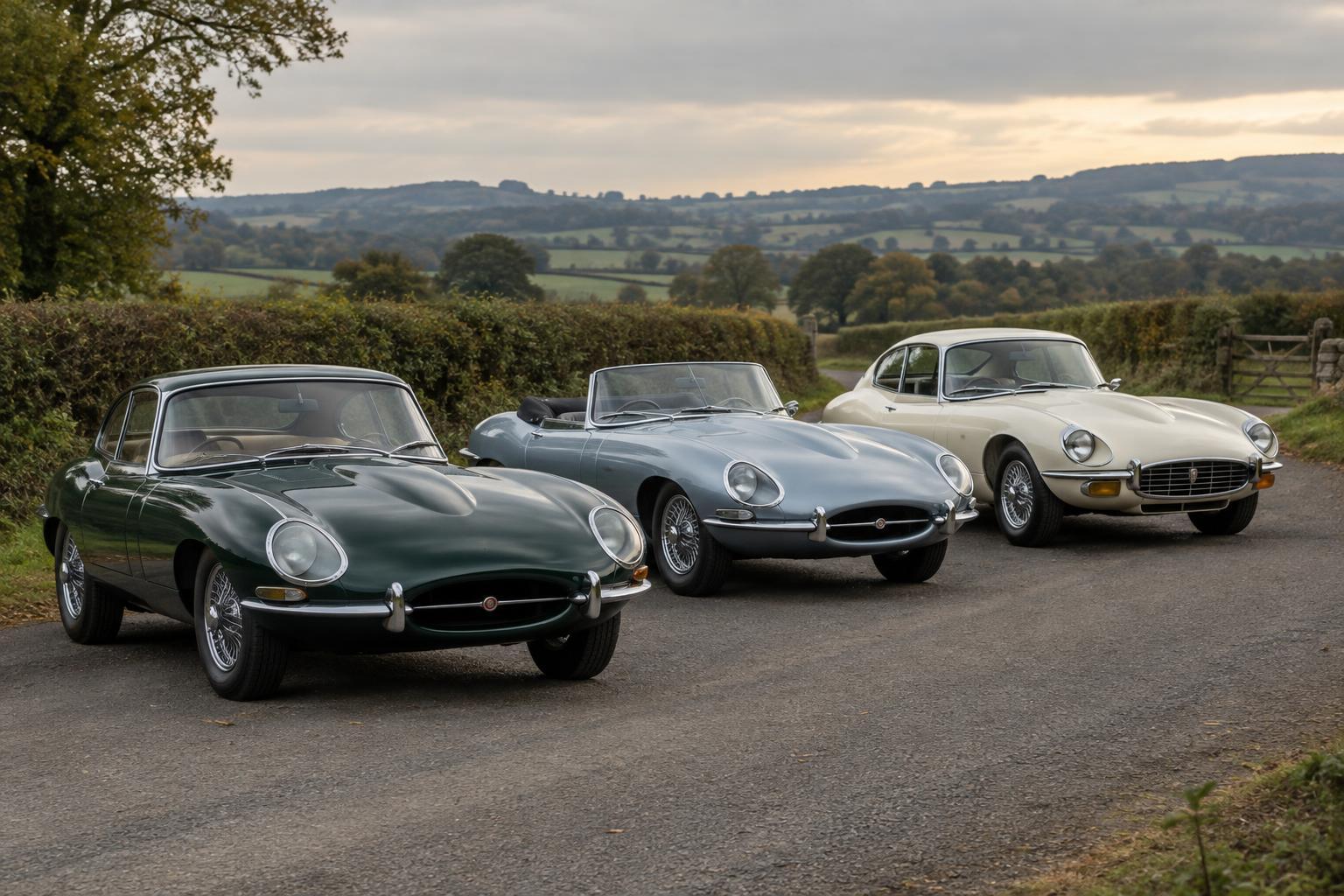
Jaguar unveiled the E-Type at the Geneva Motor Show in 1961. The initial range offered an open two-seater and a fixed-head coupé, both with the closely set proportions that define the earliest cars. Their covered headlamps, slim bumpers and small grille contribute to the clean front-end design many enthusiasts associate with the original E-Type.
Early Series 1 cars used a 3.8-litre straight-six engine. In 1964, Jaguar introduced a 4.2-litre version. The change did not transform the car’s basic character, but it brought a different balance of everyday drivability; the 4.2-litre cars also gained a fully synchronised gearbox. A longer 2+2 coupé joined the range in 1966, offering small rear seats and more luggage flexibility at the cost of the shorter cars’ particularly neat proportions.
Series labels are useful shorthand, but they do not capture every running change. Late six-cylinder cars are sometimes called “Series 1½” because they retained much of the first series while adopting features associated with the next phase, notably open headlamps. Market requirements also affected specifications, so two cars from similar years may not be identical.
Series 2: Refining the everyday E-Type
Introduced in 1968, the Series 2 made the E-Type easier to distinguish at a glance. Open headlamps became a defining feature, while a larger front intake, altered lighting and revised bumpers changed the appearance without abandoning the original outline. Jaguar also made updates aimed at cooling, usability and safety. Inside, changes to controls and trim gave the cabin a different feel from that of the earliest cars.
The Series 2 continued with the 4.2-litre six-cylinder engine and was available in open two-seater, fixed-head coupé and 2+2 forms. Its evolution was partly shaped by differing rules in export markets, particularly concerning lighting, emissions and occupant protection. For anyone comparing surviving examples, it is worth identifying the intended market and checking the individual car’s specification rather than assuming that every Series 2 left the factory in exactly the same form.
These changes can divide opinion. Some prefer the first series’ uncluttered appearance; others find the later six-cylinder cars appealing because their revisions suit regular use. Neither preference changes the central point: the Series 2 remained recognisably an E-Type while responding to the demands of a changing car market.
Series 3: A different kind of grand tourer
The Series 3 arrived in 1971 with the most substantial change of the E-Type’s life: a 5.3-litre V12 engine. It also adopted the longer wheelbase associated with the 2+2 body. Buyers could choose an open two-seater or a 2+2 coupé, but the short-wheelbase fixed-head coupé was no longer part of the range. A broader grille, flared wheel arches and other detail changes gave the V12 cars a more imposing presence.
Where an early six-cylinder E-Type can feel like a lean sports car, the Series 3 places greater emphasis on smooth, effortless touring. That distinction is useful when considering the model’s history. The three series are not simply successive attempts to perfect one specification; they reflect different priorities, from the original car’s startling debut to greater practicality and, finally, V12 refinement.
The E-Type’s lasting appeal lies partly in that variety. Looking closely at its body styles, engines and incremental changes reveals a car shaped both by Jaguar’s initial design ambition and by the practical pressures of keeping a grand tourer relevant over more than a decade.