A brief shaped by economy
The original Mini began as a practical answer to a difficult question: how could a small, affordable car carry four people without feeling like a compromise at every turn? In the mid-1950s, concern about fuel supplies strengthened the case for economical motoring. At the British Motor Corporation (BMC), Alec Issigonis was given the task of developing a compact car that made unusually effective use of its road space.
Issigonis approached the problem as one of packaging. A conventional small car devoted much of its length to an engine at the front and driven wheels at the back. Reducing the car’s overall size by simply shrinking that arrangement would also reduce useful cabin space. The Mini’s design instead reorganised familiar components so that more of the car’s footprint could be used by passengers and luggage.
The result was not the work of one person alone. Issigonis directed a development team, and specialists contributed to the suspension, engineering and production of the car. His central idea, however, gave the project its character: start with the room people need, then make the mechanical layout serve that space.
Putting the machinery in its place
The Mini used front-wheel drive and mounted its four-cylinder A-series engine across the car rather than along it. The gearbox sat beneath the engine, sharing its oil, which helped keep the power unit short from front to back. This left room for a passenger compartment that was generous relative to the Mini’s modest exterior dimensions. It also produced an engineering layout that would become widely influential, even though later small cars did not necessarily copy its gearbox arrangement.
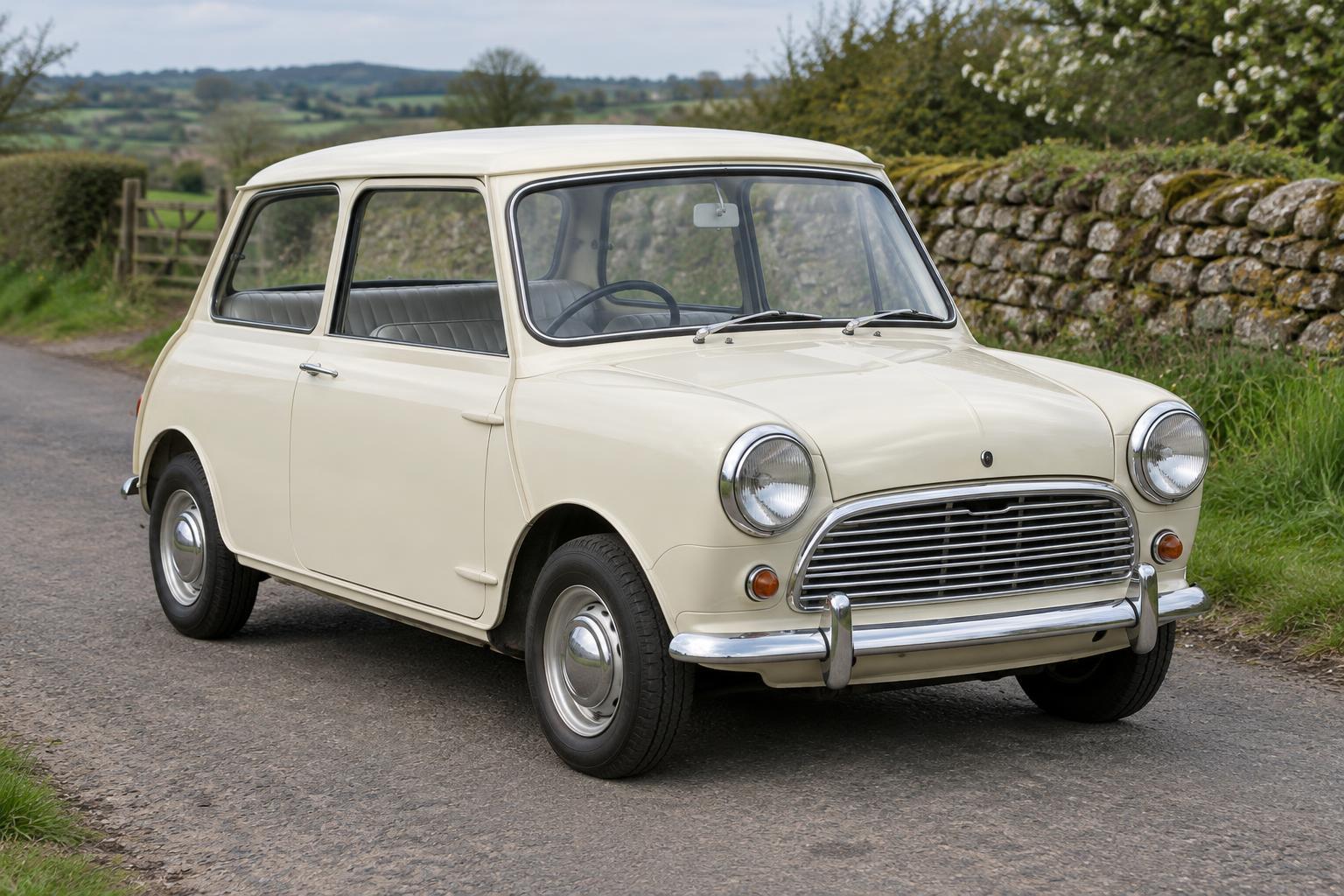
Other choices supported the same goal. Small wheels helped keep the body compact, while a wheel at each corner gave the car a long wheelbase for its length. The doors had useful storage bins, and sliding windows avoided the space needed for conventional winding mechanisms. Exposed body seams and external door hinges were among the visible signs of a design that favoured straightforward construction and interior room over a smooth, conventional appearance.
These decisions involved trade-offs. Sliding windows and a tiny boot were not everyone’s idea of refinement, and the tightly packed mechanical layout could make some maintenance jobs awkward. Yet the combined effect was striking: the Mini looked small from the pavement but felt remarkably usable once its doors were opened.
The 1959 launch and the driving experience
BMC introduced the car in 1959 under two names, the Austin Seven and the Morris Mini-Minor. The different badges reflected BMC’s established Austin and Morris sales networks, but the cars shared the same fundamental design. Early buyers encountered something unlike most other inexpensive British cars of the period: low seating, light weight and a cabin arranged around the occupants rather than a traditional driveline.
The suspension was another important part of the character. Developed with Alex Moulton, it used compact rubber cones in place of conventional steel springs. This saved space and contributed to the Mini’s direct response on the road. Together with front-wheel drive and its stance on the road, the layout made the car feel eager in corners. It was designed as practical transport, not initially as a sports car, but its handling soon became central to its reputation.
That lively feel should not obscure the Mini’s everyday purpose. Its most important achievement was making a small car useful. Passengers could occupy space that a more conventional design might have surrendered to mechanical parts, while the car remained easy to place on narrow streets and roads.
Early development, not a finished formula
The first Minis established the concept, but they were not the final word on it. BMC made running changes as production and everyday use revealed where the car could be improved. Early ownership could require tolerance of noise, weather protection and the practical consequences of such tightly packaged mechanical parts. Those limitations matter when looking at an early example today: they are part of its period design, not always evidence that a particular car has been neglected.
The basic layout also proved adaptable. The Mini Cooper, developed with racing-car builder John Cooper and introduced in 1961, showed how stronger performance could build on the small car’s handling. Other body styles extended the Mini idea to different uses. These developments grew from the original packaging rather than replacing it.
For a classic-car enthusiast, the earliest Mini is fascinating because its design choices remain easy to see and feel. Its space-efficient cabin, unusual powertrain arrangement and compact suspension all answer the same question Issigonis faced at the outset. The car became a cultural favourite for many reasons, but its lasting historical importance begins with a clear engineering idea: make every inch count.