A larger Rover for a changing market
When the Rover P5 arrived in 1958, it offered buyers a larger, more imposing alternative to the company’s earlier saloons. Rover had long cultivated an image of careful engineering and quiet respectability. The P5 carried that character into a car intended for people who wanted generous accommodation and a dignified arrival rather than conspicuous sportiness.
The original P5 was a four-door saloon powered by a three-litre six-cylinder engine. Its upright grille, broad passenger compartment and measured styling gave it a presence that suited formal journeys, while its size and comfort also made sense for long-distance private use. The P5 became associated with official transport, but that association is only part of its story: it was also a car that individuals could choose for family travel and everyday motoring.
From saloon to four-door Coupé
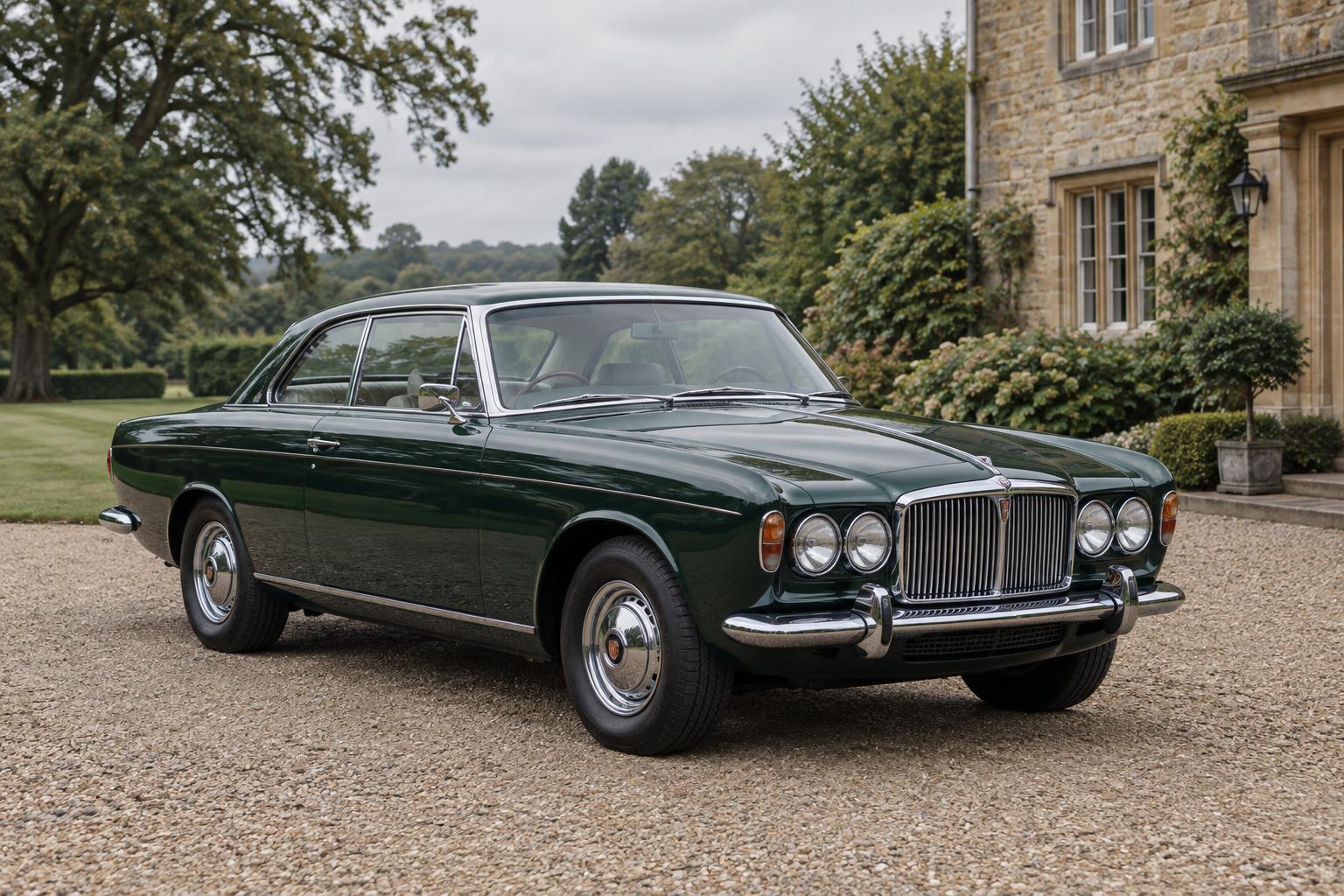
The most distinctive addition to the range was the P5 Coupé, introduced in 1962. Despite its name, it retained four doors. Its lower roofline and altered window shapes gave it a sleeker profile than the saloon without abandoning the usefulness of a full-size passenger car. That combination remains central to the Coupé’s appeal: it looks notably different, yet it is recognisably part of the same family.
The change involved a practical compromise. The saloon’s taller roof better serves passengers who value an airy cabin and easier rear-seat access, while the Coupé places greater emphasis on style. Interior finishes varied across cars and through the years, but the sense of occasion came as much from the P5’s proportions and seating position as from its trim. For someone learning the range, roof shape is often the quickest way to distinguish the two bodies.
The three-litre years and the arrival of the P5B
Rover refined the six-cylinder P5 through successive versions, commonly identified as Series I, II and III. Changes to the engine, equipment and details of the body and cabin mean that cars from different years need not feel identical. The series labels are useful signposts, but a surviving car’s condition and the work done to it may matter more to an owner than a small difference in original specification.
A bigger change came in 1967 with the P5B. The letter B referred to the Buick origins of its aluminium 3.5-litre V8, adapted by Rover for its own cars. The engine gave the heavy P5 a different character, with smoother, more effortless-feeling acceleration than buyers might expect from its reserved appearance. Both saloon and Coupé bodies continued, so the P5B was a new mechanical chapter rather than a replacement for the Coupé.
This distinction helps prevent a common mix-up: “P5” names the broader model family, “Coupé” describes a body style, and “P5B” identifies the V8-powered version. A P5 Coupé can therefore have either the earlier six-cylinder engine or, in P5B form, the V8.
Why the P5 came to symbolise authority
The P5’s link with official life was a natural fit for its design. It was substantial without being showy, and its rear compartment offered the space expected of a formal car. Government use helped establish its public image, but the car did not depend on official service for its identity. Its appeal lay in the balance between presence and restraint, a quality that distinguished it from both smaller family cars and overtly sporting models.
Production ended in 1973, after the P5 had remained in the range alongside newer Rover designs. That long overlap is revealing. The P5 served a particular kind of customer: someone who valued its traditional appearance, room and unhurried manner. Later Rovers took the marque in other directions, but they did not erase the P5’s place in British motoring culture.
Reading a P5 as a classic today
For an enthusiast encountering a P5 now, the first questions are simple: saloon or Coupé, six-cylinder or V8? Those choices shape the car’s appearance and driving character. Beyond them, originality can be less straightforward. Over decades, trim, mechanical components and even complete engines may have been changed, so an individual car is best understood on its own evidence rather than its badge alone.
The P5 rewards attention to the details that make an older executive car pleasant to use: sound bodywork, a tidy cabin, functioning equipment and a drivetrain that behaves consistently. Restoration can preserve its formal character without treating every sign of age as a flaw. Whether viewed as a piece of design history or enjoyed on a quiet cross-country journey, the P5 remains a clear expression of Rover’s traditional approach to the large British saloon.